
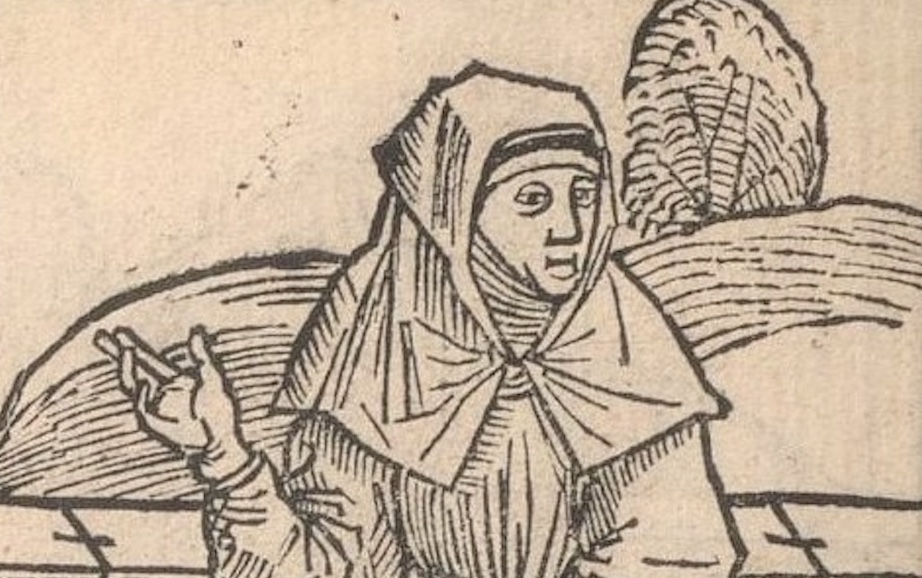
After Socrates, no death in Western history has influenced the course of thought as profoundly as those of two women: Hypatia and Marguerite Porete, both victims of institutionalized religious hatred. The stoning of Hypatia symbolizes the stoning of ancient philosophy, while the burning of Marguerite represents the burning of medieval mysticism.
Marguerite Porete, who came from an aristocratic family in Hennegau in the Walloon region of present-day Belgium, received her primary education under the guidance of private tutors. From a young age, she joined Beguine communities and traveled to various cities. Beguine mysticism, influenced by the mendicant orders, spread from the Flanders region to the entirety of Western Europe in the 13th century. Unlike formal religious orders, the Beguines lived in small, semi-independent communities of women, practicing their faith through a combination of handicrafts, charitable activities, and ongoing religious education.
Marguerite, like other Beguines, engaged in these communal activities while deepening her theological knowledge. She is referred to as a clergesse in historical chronicles, denoting her significant theological expertise. This expertise is evident in her seminal work, Miroir des simples âmes (The Mirror of Simple Souls), one of the earliest religious texts written in French. Composed in the late 13th century, the text was quickly translated into four languages and became one of the most influential works in medieval Christian literature (Ruh, 63).
However, the widespread influence of Miroir des simples âmes among both independent women’s monasteries and Papal orders such as the Dominicans led to controversy. Allegations arose that Marguerite’s writings contained views contrary to Catholic doctrine and belittled traditional worship. These accusations soon reached the Papacy, prompting an inquisitorial investigation in 1309. The theological commission found heretical expressions within the text and decided to excommunicate it.
Imprisoned and put on trial, Marguerite chose to remain silent throughout the proceedings. Her silence and steadfastness did not sway her accusers. In June 1310, she was burned at the stake in the Place de Grève, a tragic end to a life dedicated to mysticism and religious contemplation.
The 14th century was a period marked by significant shifts as the centrality of religious life began to wane, paralleling the breakdown of feudal societies and the emergence of diverse spiritual pursuits. The lingering influence of Cathar-like movements in southern Europe, combined with the spread of women’s societies and orders in the west, complicated the Church’s efforts to maintain control over religious life. The cultural threat posed by Islam in the south and the debates on Averroism in universities further fragmented the religious landscape.
In this era of multifaceted crises, Marguerite composed her work, Miroir des simples âmes, preaching its contents in monasteries and gaining attention from various communities. The Inquisition, perceiving her ideas as dangerous, accused Marguerite of persisting in her beliefs despite the work’s prohibition. Her execution in 1310 was not the end of the Church’s efforts to suppress the Beguines, as trials and persecutions continued harshly until 1350. The Church’s concern was evident: the spiritual life outside its authority, embodied by Marguerite Porete, threatened religious integrity.
Paris in 1310 was a vibrant hub for mystics and intellectuals. Meister Eckhart lectured at the Dominican convent, Ramon Llull expounded on his Ars at the university, and Dante Alighieri spent time in the city before returning to Northern Italy. Like Marguerite, these thinkers—who wrote in German, Catalan, and Italian—championed the use of the vernacular. Marguerite’s influence was most palpable on Eckhart, a significant mystical thinker of the Middle Ages (Ruh, 78). Both mystics faced the Inquisition for advocating a spiritual life independent of Church authority.
Marguerite described the established religious tradition as the “little church,” while the “great church,” which harbors divine love, resided in the human soul. She posited that true spirituality was accessible to individuals outside the prescribed rituals of the Church. This notion directly challenged Catholic tradition, and notably, it was a woman who spearheaded this challenge. Despite women’s exclusion from any level of the religious hierarchy, Porete defied both the scientific and spiritual authority of the Church, asserting that a woman could attain the highest divine rank.
The Miroir, in which Marguerite describes her own spiritual ascension, is structured as a dialogue between Reason, Soul, and Love. This work includes poems, theological reflections, and excerpts from Marguerite’s life story. Her choice to write in the vernacular and employ a dialogic form can be understood within the context of Platonic tradition and mystical literature. The central theme of the book is the liberation of the mind from its external bonds and the soul’s union with God through love.
Marguerite recounts that at the beginning of her spiritual journey, she practiced extreme asceticism, abstaining from food and drink, and dedicating herself entirely to worship, yet she still could not attain divine truth. In a quest reminiscent of Siddhartha’s journey, she left her life of seclusion to seek God in the outside world, gradually perceiving divine manifestations in everything she observed. When this search proved unfulfilling, she turned inward once more, aligning herself with Augustine’s notion of finding the divine through contemplation.
To grasp the absoluteness and purity of divinity, Marguerite endeavored to purify her thoughts and abstracted her belief in God from all apparent records. Although she sought to understand the divine through the boundlessness of human contemplation and imagination, she found herself constrained by conceptual thought. This realization led her to question the concepts and religious values based on these notions. Initially, Marguerite recognized her devotion to religious virtues and her unyielding endurance of great sufferings. However, she eventually realized that she had become a slave to these virtues. Her liberation from this bondage involved not only departing from the virtues demanded by monastic life and society but also striving to purify her mind from all concepts.
Reminiscent of Plato’s criticism of the sophistic conception of virtue (arete), Marguerite Porete’s critique of scholastic virtue centers on the reduction of knowledge to rational thought and spiritual life to mere rituals. The qualities required to attain certain positions within the religious tradition stem from concepts sanctioned by religious institutions. Since conceptualization through universals is abstracted from the specific nature of particulars, it becomes alienated from reality. Consequently, internal conceptual thinking may not provide accurate information about external realities. This raises the question: how can divinity, whose reality cannot be experienced physically, become the object of metaphysical thought? This duality distances one from divine reality and reconstructs it within the constraints of conceptual thought. Thus, rational conceptions of God and God Himself are never the same. Religious virtues based on these concepts cannot be the ideals of someone seeking perfection. Without emptying the soul of all external forms and the correlates of thought and imagination, divinity cannot be born within.
Marguerite describes the liberation from the external bondage of intellect and the internal bondage of concepts aimed at virtues as ame anientie —the annihilation of the soul. This perspective diverges from Platonists, who attribute virtues to intellectual principles. But what will the soul be filled with, if not with intellectual possibilities, concepts, thinking, and imagination? According to Marguerite Porete, this question is inherently flawed as it is conceived within the limitations of intellect. Divine transcendence lies beyond perception and imagination. She reflects: how foolish I was! It was as if I was holding a torch or a lamp in my hand and I was trying to illuminate the sun with it. (Porete, 146).
Later in her spiritual journey, Porete realized that the highest veil before God is the desire for Him. Initially, she understood the distinction between the goal and the means to that goal, which led her to a profound revelation: man’s willlessness in God is greater than willing God. In other words, she had to abandon even the hope of God, which had become her sole meaning. This revelation is another aspect of her critique of rational theology. She believed that anything willed is objectified. When one makes God the subject of thought or the object of hope, He is objectified, entering the realm of duality and limitation. Conversely, God is one and absolute. She realized that the soul essentially consists of nothingness, which is the absence of anything other than God, including the absence of an orientation towards God. The only metaphor that can describe this purified soul is the mirror. Unlike scholastic theology, Porete uses mirror (miroir) rather than image (imago) to reference the Bible. Only love transforms a person into the mirror of God (Porete, 112) because what is reflected in the mirror has no independent existence from what it reflects—love.
Marguerite reached the summit of mountains, beyond winds and rains (Porete, 103): I was a prisoner in the dungeon of time, held captive by longing hopes. When my hope, my will, and my vision, which had kept me from the gifts of divine love, tasted death, (then) I found myself in the shining light of divine love. (Porete, 38). In this state, there is no subject or object; the reflected, the reflector, and the mirror are love itself, making love synonymous with God. What distinguishes love from knowledge and action is its freedom from duality. Knowledge expresses the particular in man and the absolute in God; any concept other than love brings ontological distinction. Love is not a bond or medium between man and God: What a difference between the lover’s gift to his beloved through an intermediary and the lover’s gift to his beloved without an intermediary! (Porete, 21).
Love is exclusive to itself, giving existence to the world from the existence of God. Since both the giver and the given are love, there is no duality, only a complete unity in existence (unio mystica). Porete’s anéantissement signifies liberation from human limitation. Meister Eckhart would describe this as Abgeschiedenheit: The longer the mirror remains empty, the more perfectly it will reflect the infinite goodness (bonté) of God (Porete, 39).
God and human become one in the soul, though concepts, virtues, and numerous veils obstruct this experience. Love, experienced as love and being filled with love, purifies the soul to such an extent that it can see neither itself nor God. Instead, God beholds Himself in it (in that soul), with it and without it. God shows him that there is no being other than him (Porete, 197).
Further reading:
Marguerite Porete, Le Mirouer des simples ames, Margaretae Porete, Speculum simplicium animarum (R. Guarnieri), Turnhout 1986
Marguerite Porete, The Mirror of Simple Souls, (E. L. Babinsky), Classics of Western Spirituality, New Jersey 1993.
Bernard Mcginn, Meister Eckhart and the Beguine Mystics, Continuum, NewYork 2001.
Ulrike Stölting, Christliche Frauenmystik im Mittelalter: historisch-theologische Analyse, 2005.
Kurt Ruh, Geschichte der abendländischen Mystik: Frauenmystik und Franziskanische Mystik der Frühzeit, II. Cilt, Beck, Münih 1993.

 Selman Dilek
Leave a comment